Responsible AI use key to competitiveness
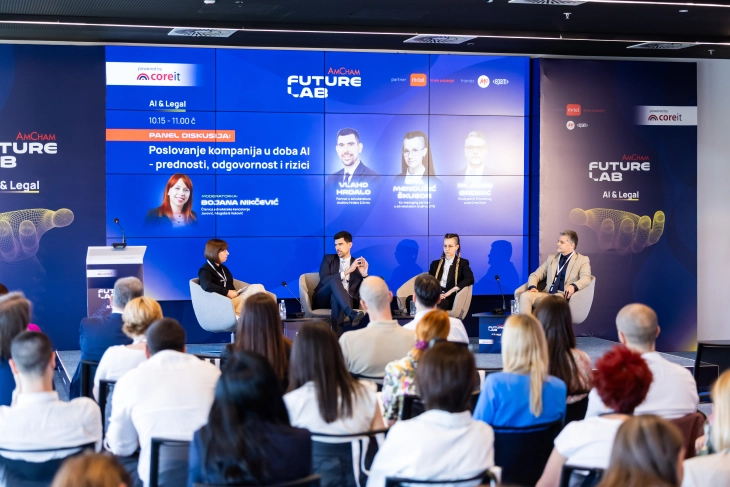
Podgorica, (MINA-BUSINESS) – It was concluded at the AI & Legal conference that it is crucial for the business community to view artificial intelligence (AI) not merely as a technological trend, but as a tool that can significantly enhance companies’ competitiveness when used properly and responsibly.
“Organizations that successfully integrate AI into their processes will be faster, more efficient, and better prepared to meet market demands,” speakers said at AI & Legal, the inaugural edition of the AmCham Future Lab platform launched by the American Chamber of Commerce in Montenegro (AmCham).
Marko Mirocevic, Executive Director of AmCham, said that AmCham Future Lab creates space for discussions on topics currently at the forefront of the global business community, as well as their practical relevance for Montenegrin companies, institutions, and the market.
“Artificial intelligence is one of the most widely discussed topics globally today, across companies, institutions, academia, and regulatory bodies alike. Through AmCham Future Lab, our goal is to bring these global conversations closer to the Montenegrin business community and address them in a way that is practical, relevant, and responsible,” Mirocevic said.
He added that AI offers tremendous opportunities for growth, efficiency, and innovation, but it also requires knowledge, caution, and clear rules.
“That is why we want to discuss not only how companies can use AI tools, but also how to use them responsibly, with a clear understanding of the legal, ethical, regulatory, and business implications. This is precisely where we see the value of AmCham Future Lab – transforming topics that shape the global marketplace into meaningful dialogue and practical knowledge for our companies and institutions,” Mirocevic said.
The conference programme opened with a keynote address by Vladimir Vulic, President of
Digitalizuj.me, digital strategist, and one of the region’s most recognized advocates of innovation and digital transformation. He said that the impact of artificial intelligence should not be viewed solely through the lens of technological advancement, but also through the changes it brings to people, organizational culture, and ways of working.
“Artificial intelligence will not only change the way we work, but also the way we learn, collaborate, and make decisions. However, AI is not primarily a story about technology; it is a story about people and their ability to adapt to a new reality. Organizations that invest in the development of their people as much as they invest in technology will have the greatest chance of success. The future of business will not belong to those with the most technology, but to those who successfully combine human creativity, empathy, and critical thinking with the opportunities offered by artificial intelligence,” Vulic stated.
Boston-based attorney Kerry O’Shea Gorgone, specializing in artificial intelligence, intellectual property, and digital content governance, delivered a presentation titled “Making the Rules While the Game Is Being Invented – Governing AI in the US, EU, and Beyond.” She discussed regulatory approaches to AI development in the United States, the European Union, and other markets, noting that different uses of AI carry different levels of risk.
“High risk does not mean you cannot use AI. High risk means that obligations come with it. You must have human oversight, documentation, transparency, and conformity assessments. That is why we should prepare now. The question is not whether these rules will apply to you. The question is whether you will help shape them or simply live with them. Be an example already today,” said O’Shea Gorgone.
Mladen Grdinic, President of the Commercial Court of Montenegro, presented the court’s AI-
powered case law system. The Commercial Court is currently the only court using the programme as part of a pilot project.
“The AI case law system functions as a tool for searching and analyzing judicial practice and is used by judges and legal advisors. Its purpose is to connect court decisions and create a unified, accessible knowledge system. Similar systems already exist in developed legal systems and typically go through several stages of development,” Grdinic explained.
According to him, the objective is to enable more efficient use of case law and legal resources.
“The next phase of development will include linking the practice of domestic courts with the case law of the Constitutional Court and the European Court of Human Rights.
“It is very important to emphasize that the system does not make decisions and does not replace judges. This is not a system that ‘writes judgments,’ but rather a support tool. Its purpose is to provide users with access to relevant case law. By asking questions, users can prompt the system to analyze final court decisions contained in its database. This is an ongoing process of evolution and improvement, as well as an exploration of how artificial intelligence can contribute to greater consistency in judicial practice and higher-quality decision-making,” Grdinic added.
The event also featured a panel discussion titled “Business Operations in the Age of AI – Benefits, Responsibility, and Risks,” with contributions from Ema Mendjusic Skugor of DTB Law Firm and Vlaho Hrdalo of Hrdalo & Krnic Law Firm.
“There is currently enormous interest in AI, and everyone feels pressure to adopt it at all costs. Don’t think about it that way. Focus on your own organization and identify inefficiencies or shortcomings that AI could eliminate or reduce. Only then should you begin considering which technology is the right fit. AI is not a solution in itself – implementing it is merely the beginning of your journey toward greater efficiency,” said Mendjusic Skugor.
The conference also included a masterclass session titled “Responsible Use of AI in Business
Practice.”
As announced, future editions of AmCham Future Lab will cover additional themes, including AI & Tech, AI & HR, and AI & Marketing.
The AI & Legal edition was organized under the sponsorship of IT company CoreIT, in partnership with M:tel, and with the support of conference friends Domen and EPAM.


